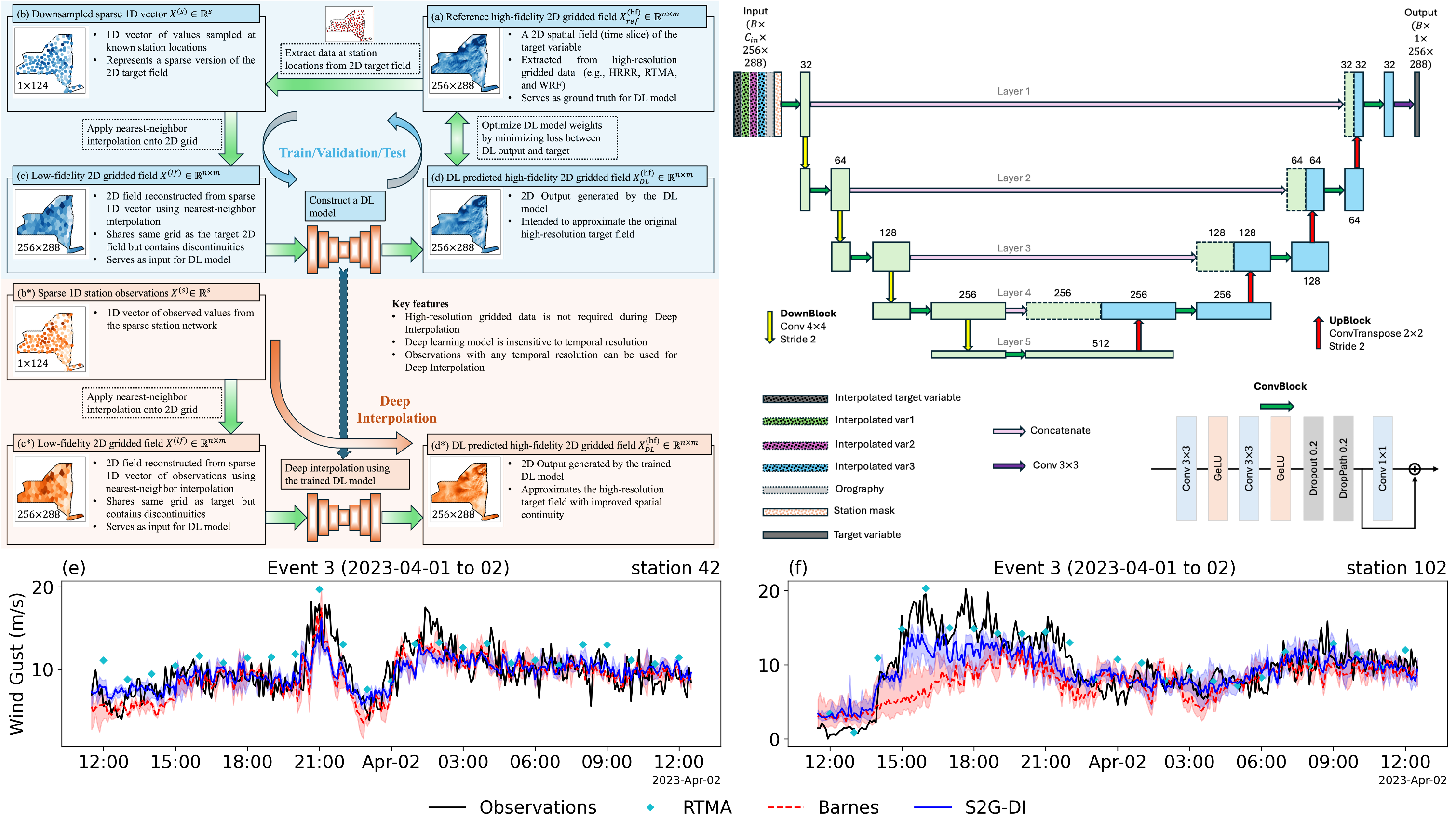
Accurate wind gust information is critical for nowcasting applications in aviation, energy dispatch, and emergency management. Surface observation networks such as the Oklahoma Mesonet provide only sparse, unevenly distributed point measurements — insufficient on their own to characterize the spatial structure of gust events at operationally useful resolution. Closing this gap without relying on computationally expensive numerical weather prediction (NWP) model runs is a practical challenge for real-time applications.
This work develops a deep-learning framework that learns the spatial mapping from sparse Mesonet observations to continuous, high-resolution wind gust fields. The architecture is designed with operational constraints in mind: inference is fast enough to support real-time nowcasting workflows, and the model does not require a dense observational grid or NWP output as input.
The resulting system produces spatially coherent gust fields from existing surface networks, offering a practical path toward operationally useful gust nowcasting — particularly in regions where station density is the binding constraint rather than model availability.